I have wanted to build a Notion alternative for a long time. I would rather stay in control of my own data than hand it to a third party.
Let’s call it LeafNote for now: notes live as plain-text files on your own drive. Sync them however you like, self-host them if you want, and never get locked into someone else’s database. “Set your notes free—and make them work better with agents.” That is the entire pitch.
People keep asking me one question about AIsa, and it is easier to answer with a demonstration than with an explanation.
The question is: “What do I actually use it for?”
What follows is the afternoon an indie developer usually spends before writing the first line of landing-page copy: estimating the market, mapping competitors, listening to what people say when they want to switch tools, finding creators who already cover the category, and choosing the first keyword. That is the go-to-market checklist.
Every number below is real. The total cost was a few dollars. I have kept the prompts exactly as I used them because if you replace “Notion” with the company you actually benchmark against, the questions themselves become the workflow.
Ten minutes of setup
I usually use Claude Code, but the process is the same in Cursor, Codex, or any agent that supports skills or MCP.
If your agent supports skills, install the AIsa skill once. It tells the agent which data sources are available, what each one costs, and how to sign in:
If your agent uses MCP, add the AIsa server. It opens a browser window for sign-in and does nothing else:
Either way, before any paid data call, the agent names the source, explains what it is about to retrieve, states the maximum cost, and waits for you to say yes. Not one step in this article ran without explicit approval. The reasoning behind that design is in Before Your Agent Spends Your Money, It Should Ask First.
Step 1: Market sizing. How big is the incumbent?
How much monthly traffic does notion.so get, and where does it come from? Use global data for the last three months.
The agent proposed two Similarweb calls, quoted the price, and I said yes. The traffic trend came back first:
| Month | Visits (global) |
|---|---|
| 2026-06 | 16,449,984 |
| 2026-07 | 4,772,858 |
| 2026-08 | 4,426,693 |
A 73% drop in one month. If you are building LeafNote, “Notion is collapsing” is a lovely belief to hold. The agent’s read was more measured. It noted that a drop this steep usually signals a domain migration, not user loss, and suggested checking the company’s social profiles for its current URL. We did that in Step 3, and it was right: Notion’s X bio now links to notion.com. The traffic moved; it did not disappear.
This is the first thing the workflow demonstrates. One source gives you a number. Two sources give you a fact. When both sit behind the same key, the second check is cheap enough that you actually do it.
Then came the August channel breakdown:
| Channel | Visits | Share |
|---|---|---|
| Direct | 3,305,660 | 74.7% |
| Organic search | 722,471 | 16.3% |
| Referrals | 294,274 | 6.6% |
| Social | 53,538 | 1.2% |
| Paid search | 33,717 | 0.8% |
| Display ads | 15,874 | 0.4% |
| 1,159 | 0.0% |
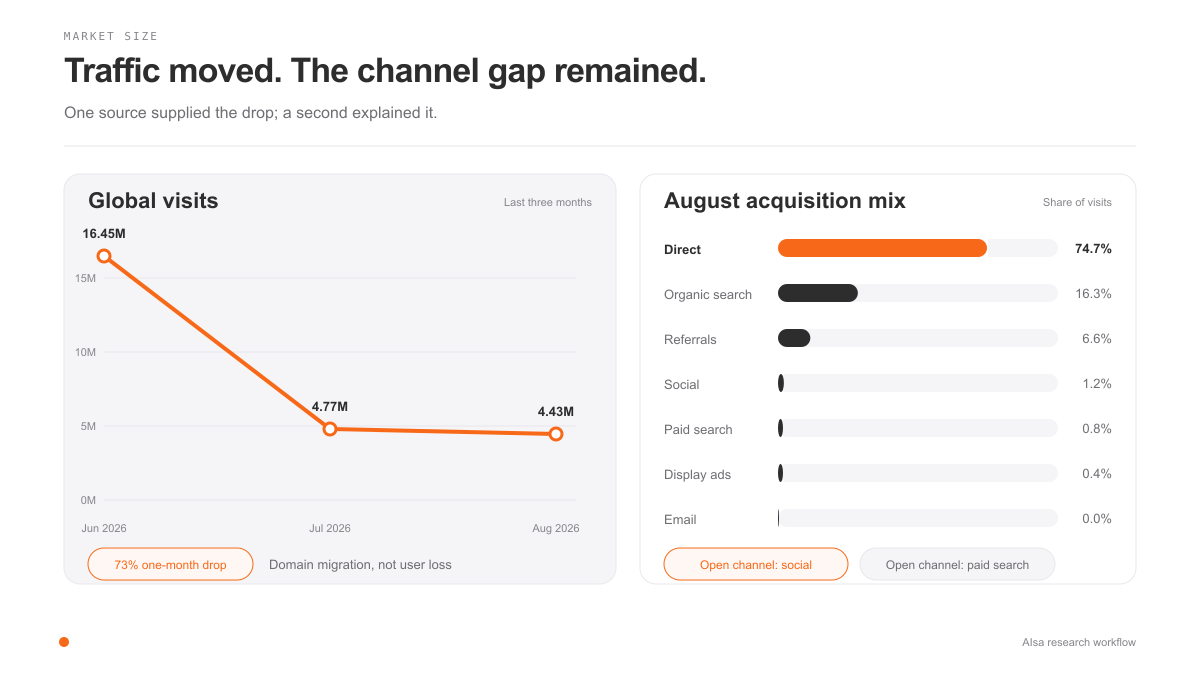
Three-quarters of the traffic comes from people typing the name directly. That is what a brand looks like. But look at the bottom of the table: social is 1.2%, and paid search is under 1%. The incumbent is barely competing in those channels. For a challenger with no brand, that is the map: go where the giant is not standing.
Step 2: Competitor analysis. What else does this audience use?
What other websites do notion.so visitors use? Give me the top five.
Similarweb’s similar-sites endpoint answered, giving LeafNote a competitor list it did not have to invent:
| Website | Global rank | Affinity |
|---|---|---|
| evernote.com | 5,761 | 1.00 |
| slack.com | 237 | 0.98 |
| larksuite.com | 4,342 | 0.93 |
| padlet.com | 2,103 | 0.89 |
| bitbucket.org | 3,289 | 0.87 |
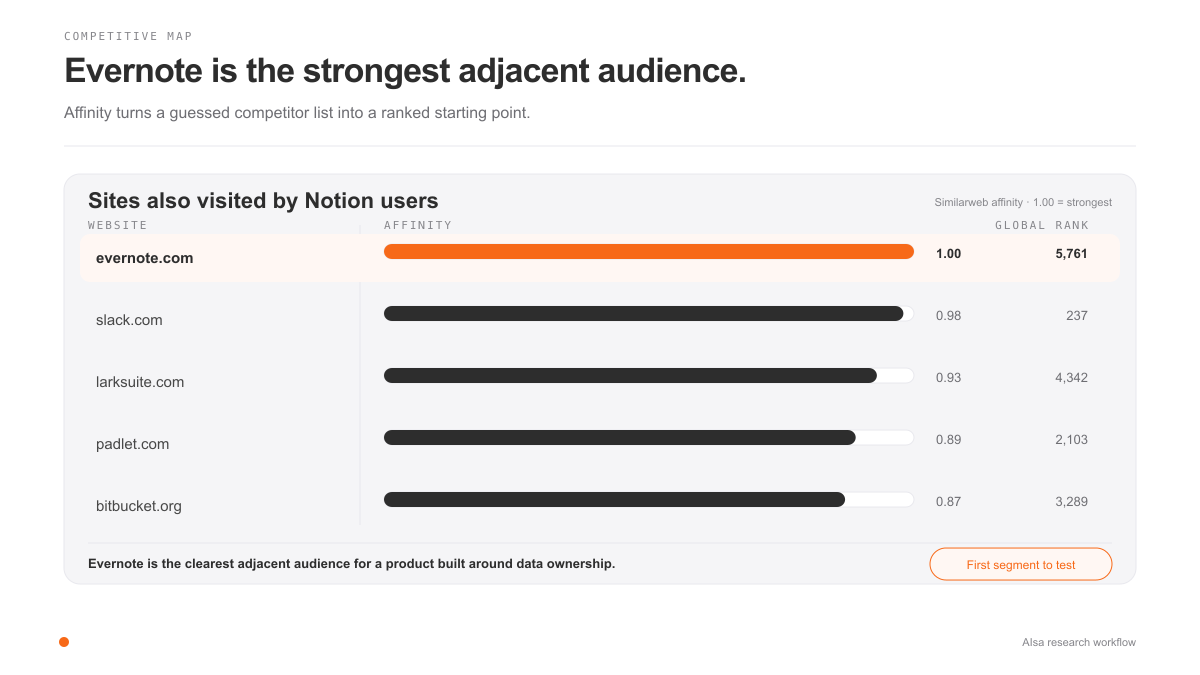
Evernote ranks first with a perfect affinity score. That is the most interesting row. Evernote users are exactly the people who say, “I want my notes to belong to me.” A product like LeafNote exists for them. You can run the two questions from Step 1 against every site in the table, and the agent is happy to process all five in one go. If you want this to run on a schedule instead of once, Build a Competitor Intelligence Agent with AIsa in 3 Hours wires the same calls into a standing agent.
Step 3: Social listening. What do people say when they want to switch?
Look up @NotionHQ on X, then search recent English posts for “notion alternative.” Exclude reposts, require at least 3 likes, and show me the posts with the most impressions.
The account details came back first: 530,131 followers, 57,669 posts, business verification, the bio “Where teams and agents think together,” and the notion.com link that solved the mystery from Step 1.
Then came the search results—twenty per page, sorted by reach:
| Account | Followers | Views | What they said |
|---|---|---|---|
| @xdadevelopers | 604,118 | 14,383 | “My favorite Notion alternative isn’t Obsidian—it’s something I can actually self-host.” |
| @thekitze | 102,428 | 23,220 | Building his own Notion alternative in public |
| @sauda_coder | 14,832 | 14,086 | A thread of free alternatives to 50 paid SaaS products |
| @rankwayio | 351 | 57,498 | “A brand-new SaaS went from 0 to 5K visitors in three months.” |
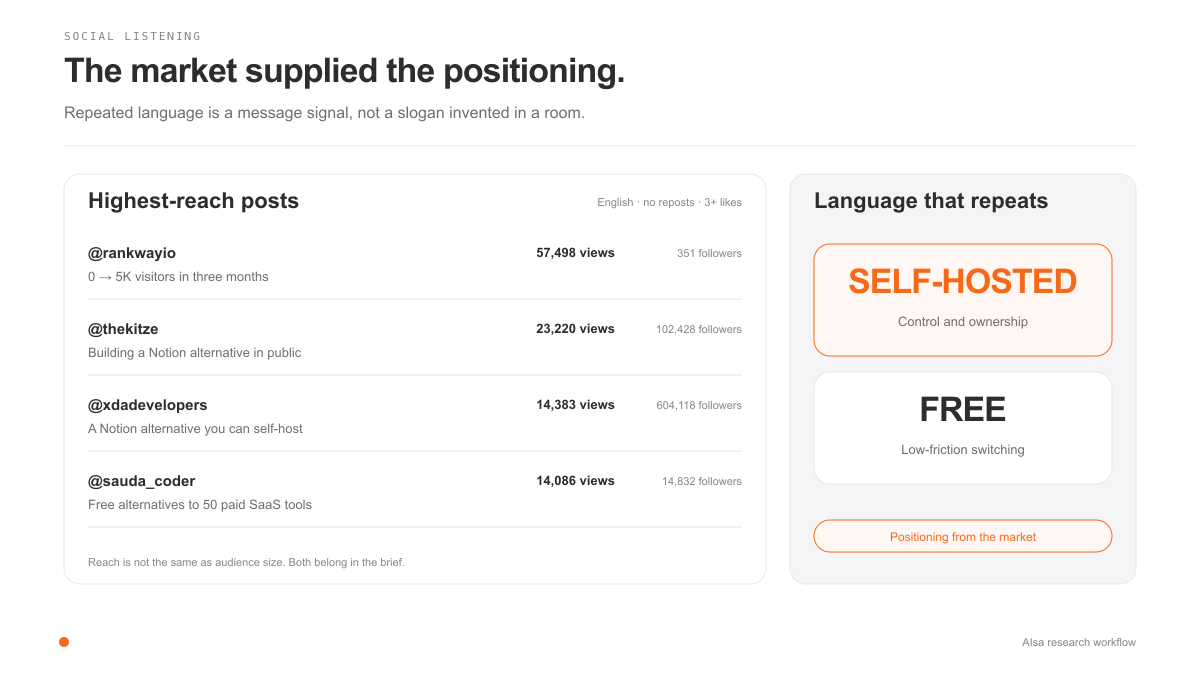
Two words kept recurring: self-hosted and free. For a fictional product whose pitch is “set your notes free,” that is positioning handed to you by strangers—without a single user interview. The agent preserves the cursor for the next page, so rerunning the search every Monday takes one line.
Step 4: Content and creators. Who already covers this category?
Search YouTube for “notion vs coda” and show me the view counts and publish dates for the leading videos.
There were 44,389 results. At the top:
| Video | Channel | Views | Published |
|---|---|---|---|
| Notion or Coda? 30 Crucial Differences | William Nutt | 20,619 | 2 years ago |
| Notion vs Coda: Which is a Better All-In-One Tool? | The Organized Notebook | 9,584 | 1 year ago |
| Notion vs Coda: Which Tool is Right for You? | Automation Helpers | 7,015 | 1 year ago |
| Notion vs Coda Comparison 2025 | Jake's Tech Lab | 1,134 | 11 months ago |
| Notion vs Coda: Which Platform Actually Scales Cheaper? | George Vlasyev | 371 | 3 months ago |
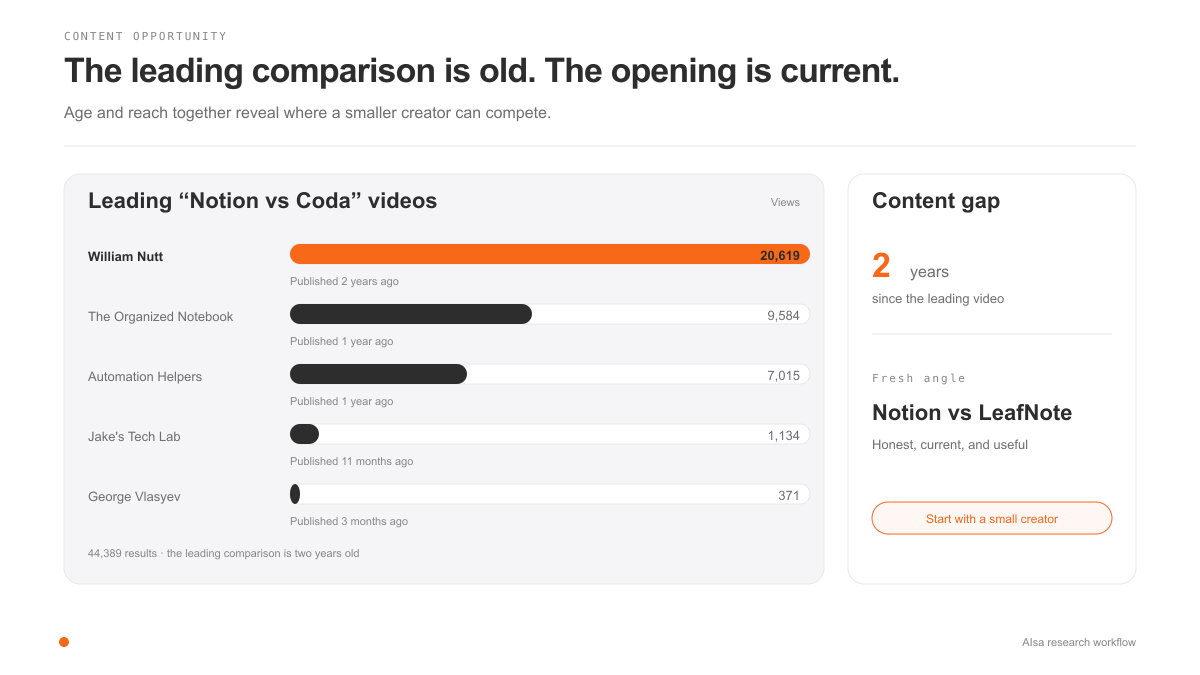
The most-watched comparison video is two years old. The category’s video content is stale, which means a small channel has a genuine opportunity to make a fresh, honest “Notion vs LeafNote” video. Those five channel names also form a ready-made creator shortlist.
Instagram is worth one question too: before you spend a month on the platform, find out whether the audience is even there.
How many followers does notionhq have on Instagram?
489,144 followers, following 148 accounts, with the bio “The AI workspace that works while you sleep.” The audience is large; the interaction surface is small. Combine that with the 1.2% social share from Step 1 and the launch decision for an indie developer is clear: do not prioritize Instagram in the first 90 days.
Step 5: SEO keyword research. What will people search to find you?
This is usually where a Semrush subscription costs more than an indie product earns in its first month. Replace it with:
Which organic keywords does notion.so rank for in the United States? Then give me the search volume and CPC for “notion alternatives.”
First, the domain overview: U.S. rank 39,753; about 1,700 organic keywords; roughly 53,000 monthly organic visits; and an “organic cost” of $446,954. That last number is what it would cost to buy the same traffic through ads. Then came the actual keywords:
| Keyword | Position | Monthly searches | CPC |
|---|---|---|---|
| notion login | 1 | 33,100 | $12.78 |
| notion | 2 | 673,000 | $3.59 |
| notion app | 4 | 18,100 | $4.16 |
| nousion | 2 | 14,800 | $5.31 |
| notion log in | 1 | 2,900 | $6.99 |
| notion.so | 1 | 2,400 | $3.56 |
Every row is branded—even the typo. There is not one informational query in the top twenty the agent returned. The incumbent’s domain is not defending “best note taking app” or “how to organize research notes.” Those are open to a challenger.
And then there is the most important term for a replacement product:
| Keyword | Monthly searches | CPC | Competition |
|---|---|---|---|
| notion alternatives | 1,900 | $5.37 | 0.42 |
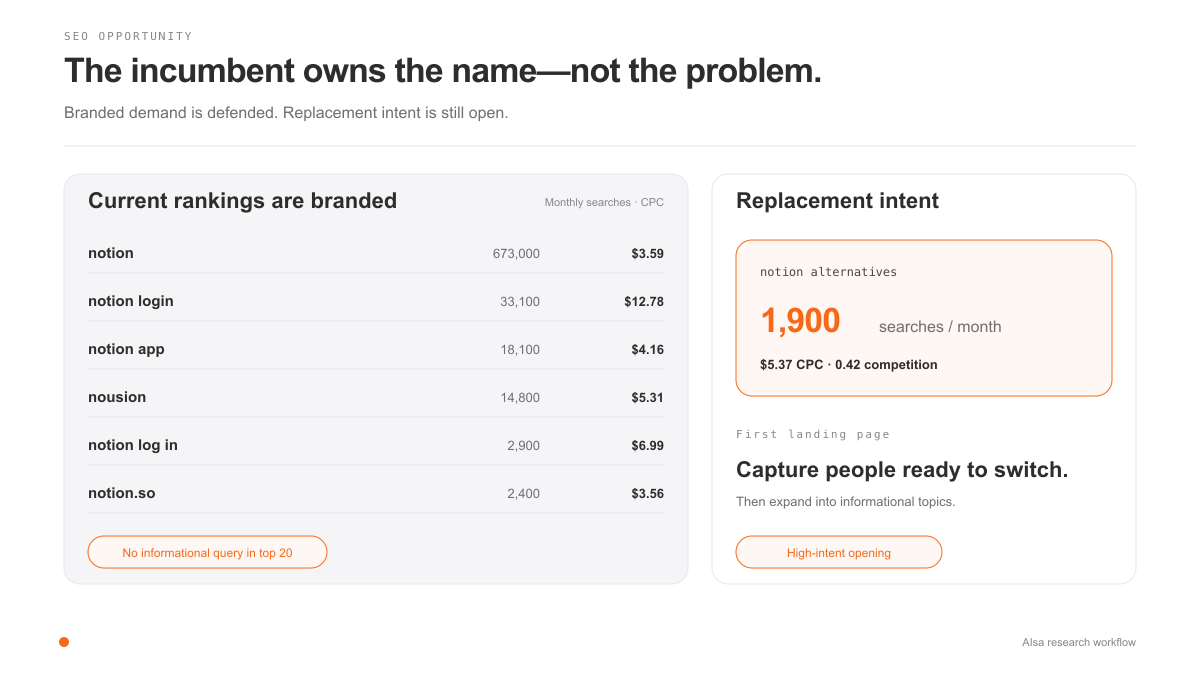
That is 1,900 people a month who are ready to switch, and advertisers pay more than five dollars per click to reach them. That keyword is LeafNote’s first landing page. One follow-up decides which article to write first:
Check the keyword difficulty for “notion alternatives,” “notion vs coda,” and “best note taking app” so I know which one to write first.
The agent combined the three terms into one call, explained that billing is per row, and waited for me to say yes. If you have the SEO Keyword Research skill installed, it clusters the entire topic instead of checking only three terms.
The one-page brief
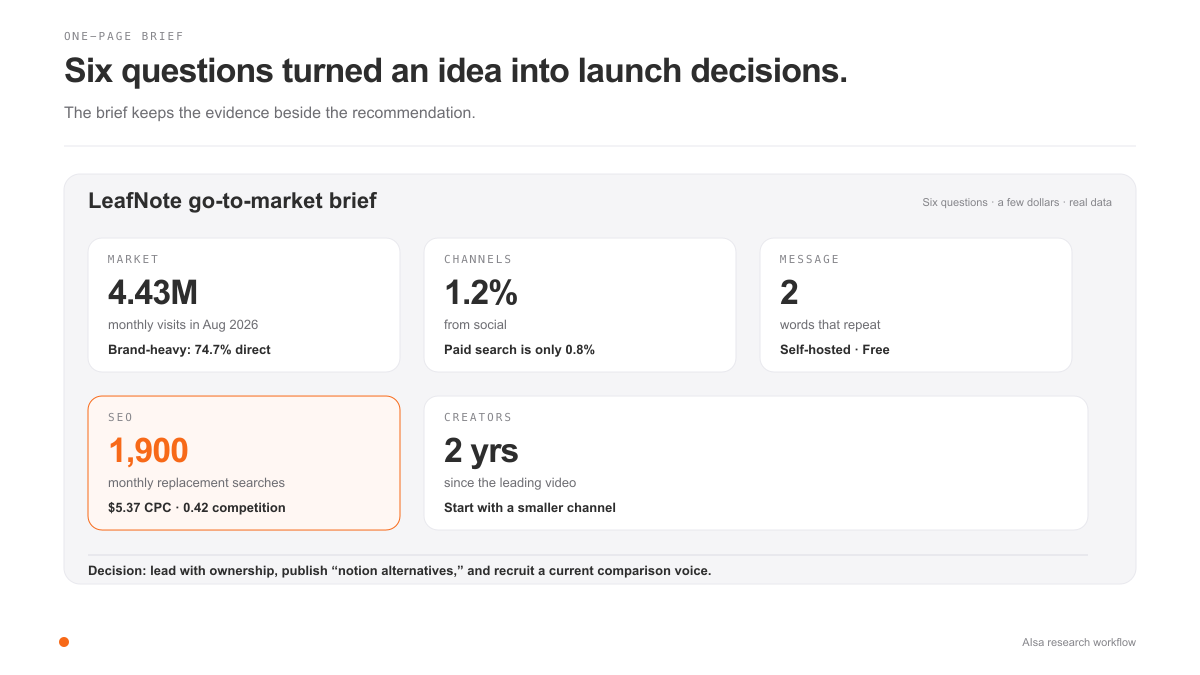
In a few minutes and for a few dollars, you have a product brief backed by real data:
-
The market is real, and it is brand-heavy. Four million monthly visits; three quarters are direct. A challenger cannot win on brand.
-
The open channels are social and paid. The incumbent is barely spending there.
-
The message is “self-hosted” and “free.” People on X say both repeatedly and without prompting.
-
The first page to build is “notion alternatives.” It gets 1,900 searches a month, carries a $5.37 CPC, and has no informational content from the incumbent defending it.
-
The first video partner should be a smaller channel. The category’s comparison videos are out of date.
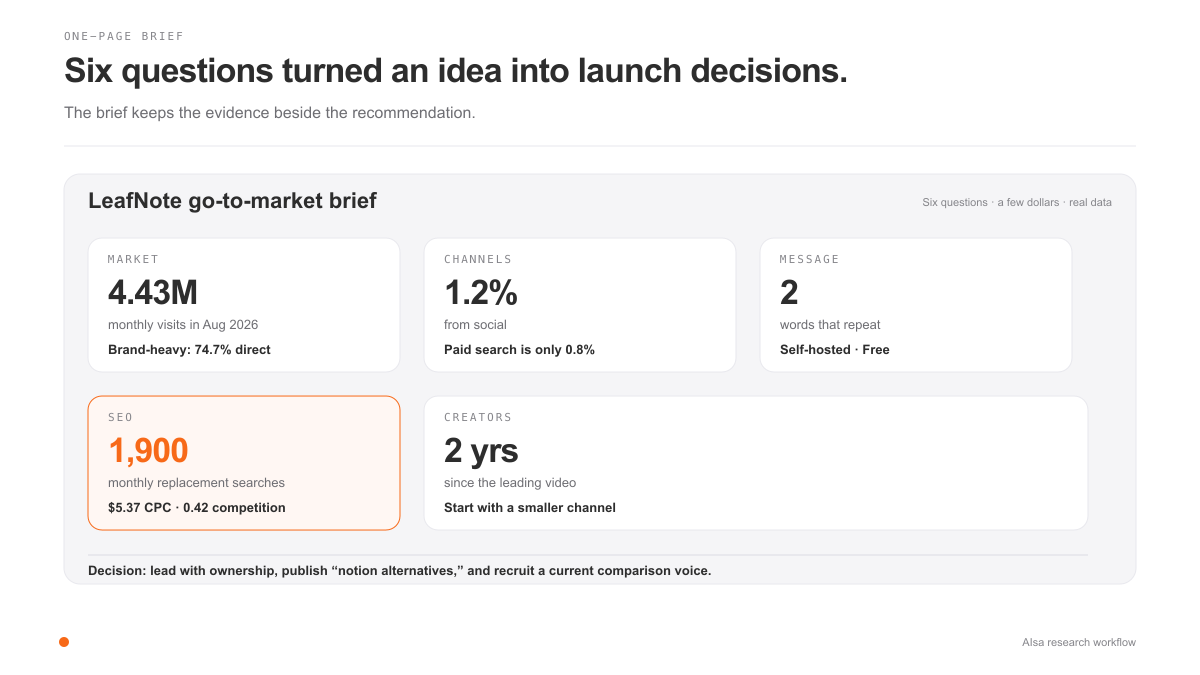
LeafNote does not exist. The brief does, and it took seven questions. Replace “notion.so” with the domain you actually benchmark against, and the same seven questions will produce the same kind of brief.
For developers who would rather have the script
Every question above maps to a call under the same base URL and the same bearer key. Parameters are documented in the API reference.
| Question | Endpoint |
|---|---|
| Monthly traffic | similarweb/website-traffic-trend |
| Acquisition channels | similarweb/website/marketing-channel-sources-legacy |
| Similar websites | similarweb/website/similar-sites |
| Domain SEO overview | semrush/domain-overview |
| Ranking keywords | semrush/domain-organic-keywords |
| Keyword search volume and CPC | semrush/keyword-overview |
| Keyword difficulty | semrush/keyword-difficulty |
| X account | twitter/user/info |
| X search | twitter/tweet/advanced_search |
| YouTube search | youtube/search |
| Instagram account | instagram/profile |
A few things the agent took care of that a script would have to handle itself: Semrush returns semicolon-delimited text, not JSON, and bills per row. Similarweb’s similar-sites endpoint requires a window of exactly three months, and its country parameter accepts only ww or us. Instagram’s account payload is about 100 KB; fetch the numeric ID once, then use the smaller basic-profile call. And before believing a traffic cliff, check for a domain migration.
What it cost
Similarweb made up most of the bill, at a list price of about ten cents per returned row. Semrush cost a few cents per row. X, YouTube, and Instagram queries each cost less than one cent. Rejected requests are not charged. The exact amount for every call appears on the usage page in the console.
If you plan to rerun Steps 3 and 5 every week before launch, the Go-to-Market plan is a better deal: $39 per month includes $50 in credits, and per-call prices are lower than on pay-as-you-go. If you only need one run, pay-as-you-go is enough.
FAQ
What are the steps of a competitor analysis for a startup?
Five, and each one is a single data call: size the incumbent's traffic and acquisition channels, map which other sites its audience uses, listen for switching intent on social, check who already makes content in the category, and pull the keywords the incumbent ranks for. Steps 1 to 5 above run them in that order.
How do you estimate market size for a startup with no budget?
Use the incumbent's traffic as the proxy. Monthly visits times channel share tells you how big the market is and where the traffic comes from. One Similarweb call costs about ten cents per row, and before you believe a sudden traffic cliff, check whether the company moved domains.
What is the best AI tool for market research?
The agent you already use. Claude Code, Cursor, and Codex all work; the bottleneck is data access, not the model. AIsa puts Similarweb, Semrush, X, YouTube, and Instagram behind one key, and the agent asks for approval before every paid call.
How much does AI-assisted market research cost?
This run cost a few dollars in total. Similarweb was most of it at roughly ten cents per returned row, Semrush a few cents per row, and X, YouTube, and Instagram under one cent per query. Rejected requests are not charged.
If you are an indie developer with more product ideas than time to research them, connect your agent to AIsa now and ask the first question. You will have an answer before your coffee goes cold—and it will be real.