
Parallel AI gives applications tools to search the web, read pages, and turn online information into research. The product at parallel.ai is built by Parallel Web Systems. Its APIs are aimed at developers who need current evidence inside an AI application, whether that means finding a source, enriching a company record, or producing a cited answer.
This guide explains the main products, how Parallel AI pricing works, and where to start. It also covers AIsa for teams that want web research alongside language models and specialized business data.
What does Parallel AI do?
An AI assistant answering a question about a supplier needs more than a plausible paragraph. It needs the supplier's actual website, relevant information from that website, and a way to connect its conclusions to evidence.
Parallel provides tools for different parts of that process. Search retrieves sources. Extract reads specified URLs. Research-oriented APIs can take on more of the work of finding information and constructing an answer. Its API selection guide distinguishes interactive requests from background research and list-building tasks.
That distinction matters when designing a product. A user waiting in a chat window has different expectations from a team enriching thousands of records overnight. Start with the output you need and the time available to produce it.
Which Parallel API should you use?
Parallel's product families cover several related jobs:
| Product | What you need | Example application |
|---|---|---|
| Search | Relevant web sources and excerpts | Find evidence for a question |
| Extract | Content from known URLs | Read a supplier's product pages |
| Responses | An answer with sources | Add web-backed answers to a chat |
| Task | Background research or enrichment | Investigate a list of companies |
| FindAll | A list checked against criteria | Find organizations in a niche |
| Monitor | Updates about new events | Track developments in a market |
Use the official quickstart links for the chosen product. These interfaces are not interchangeable: finding a page and returning a completed research answer are different tasks.
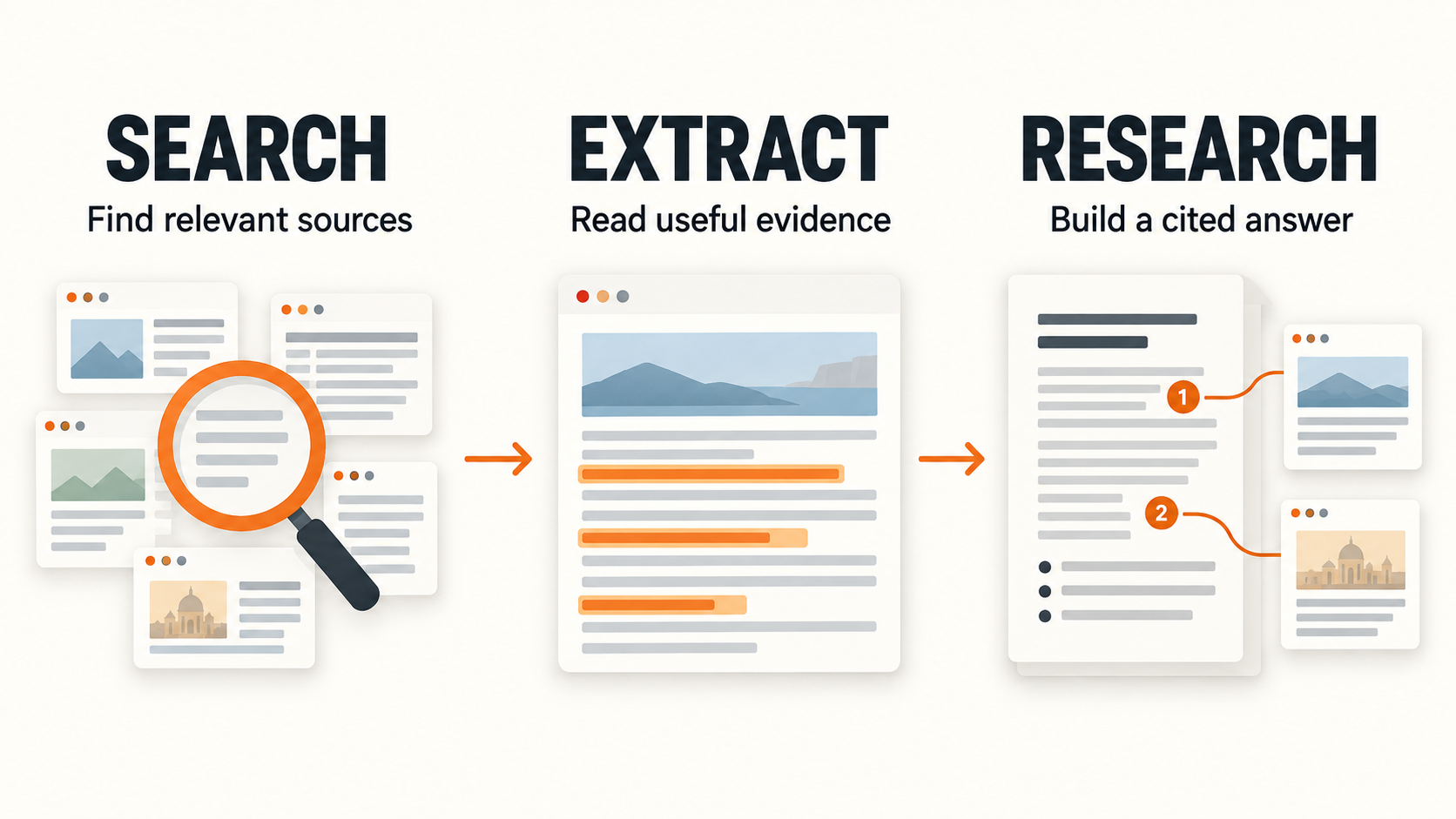
Search, extraction, and synthesis are separate stages. Your application may need one stage or several.
For example, an internal vendor directory already containing website URLs may benefit most from extraction. A market map starting with a description of suitable companies needs discovery first. Avoid adding a full research step when retrieving one known page would answer the question.
How much does Parallel AI cost?
Parallel uses usage-based pricing, with different units and tiers by product. These entry points come from its official pricing page:
| API | Published starting rate | Billing detail |
|---|---|---|
| Search | $1 per 1,000 requests | Turbo/Fast; 10 results included |
| Search | $5 per 1,000 requests | Basic/Advanced; 10 results included |
| Extract | $1 per 1,000 results | Charged by results |
| Task | $5 per 1,000 requests | Lite processor |
| Responses | $10 per 1,000 requests | Low reasoning effort |
| Monitor | $3 per 1,000 requests | Lite tier |
| FindAll | $0.25 plus $0.03 per match | Base tier |
Additional Search results cost $1 per 1,000 results. Higher research tiers cost more. At the listed Fast rate, 10,000 Search requests with no additional results cost $10 before other services.
Do not compare every row as a price for the same job. A search request retrieves evidence; a research request performs additional work. Budget for the sequence your application actually runs, including any separate model inference.
A useful evaluation records cost per completed task alongside source quality and latency. A cheaper individual call is less helpful if your application needs several retries to answer the user's question.
How to get started with Parallel AI
Create a key in the Parallel platform and follow its Search quickstart. New Search integrations use POST /v1/search, authenticated with an x-api-key header. The request accepts a natural-language objective and optional search queries; results contain URLs and excerpts.
Begin with a specific objective: “Find the official documentation explaining this vendor's data-retention policy.” This is easier to evaluate than “research the vendor.” Inspect whether the returned pages answer the question, then test a small batch of realistic tasks before expanding the integration.
Keep the key on your server. Save source URLs with your results, handle errors explicitly, and set a limit on retries. When a result is incomplete, return that limitation instead of silently filling the gap with a model's guess.
Watch an introduction to Parallel
This Kleiner Perkins video introduces the company's approach to web infrastructure for AI. It offers product context rather than a step-by-step integration tutorial.
When AIsa is useful for web research
Parallel is worth evaluating for its dedicated web research tools. Some projects also need information beyond public pages: website traffic, SEO metrics, social data, and a language model to interpret the results. That is where AIsa's API catalog offers another useful starting point.
AIsa provides supported search, data, and model capabilities through a shared account and API credential. The practical benefit is fewer separate credentials and billing relationships when your research workflow spans several services. Each capability still has its own request format and rate, as the AIsa architecture guide explains.
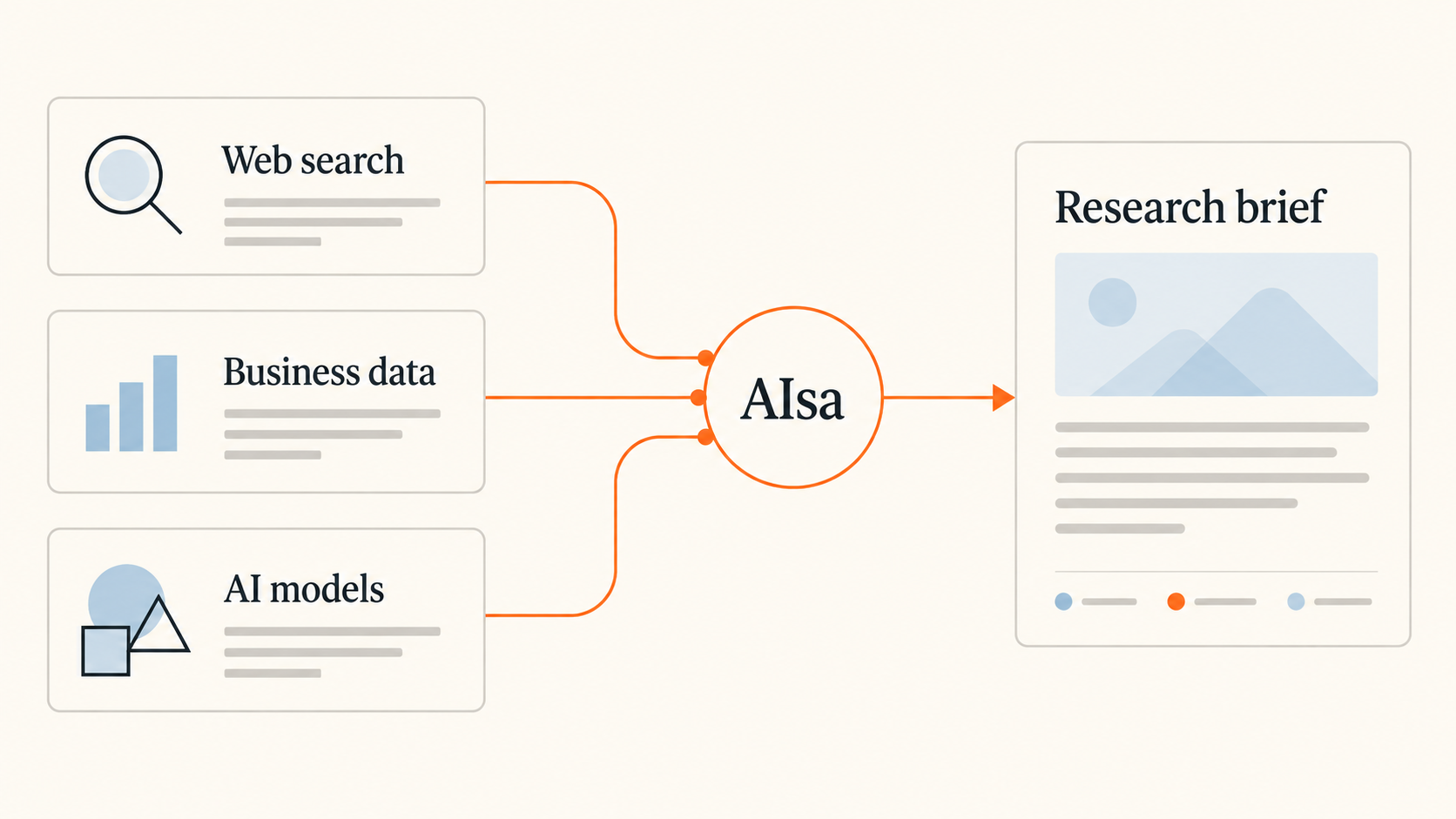
An illustrative application architecture: combine the capabilities your research needs through AIsa.
For a simple starting point, use Tavily search through AIsa. Set AISA_API_KEY in your server environment, then request a few relevant sources:
curl --fail-with-body --connect-timeout 10 --max-time 60 \
  https://api.aisa.one/apis/v1/tavily/search \
  -H "Authorization: Bearer ${AISA_API_KEY}" \
  -H "Content-Type: application/json" \
  -d '{
    "query": "official documentation enterprise data retention policies",
    "search_depth": "basic",
    "max_results": 5
  }' > search-results.json
Use the returned titles, URLs, and content excerpts as evidence for a later model call. The AIsa Tavily integration guide explains this search path. A market-research application could then add relevant business data and ask a supported model to write a source-linked brief.
This is a separate AIsa workflow, not a way to call Parallel through AIsa. Explore the model catalog and compare all plans around the capabilities your application needs.
Five tips for evaluating Parallel AI
- Define a useful answer. Specify the fields, sources, and level of detail your application needs.
- Test representative questions. Include ambiguous names and questions with incomplete public evidence.
- Read the citations. A relevant-looking source may not support the exact claim being made.
- Measure the full workflow. Include retrieval, model calls, retries, and user-visible waiting time.
- Preserve missing values. Unknown information should remain unknown rather than becoming a confident guess.
Five web research API terms to know
- Retrieval: Finding existing information relevant to a request.
- Extraction: Turning content from a specified page into usable data or text.
- Grounding: Connecting generated claims to supplied evidence.
- Structured output: A response organized into defined fields that software can process.
- Asynchronous task: Work submitted now and retrieved after processing finishes.
Parallel AI FAQ
What is Parallel AI used for?
Parallel Web Systems provides APIs for web search, extraction, research, entity discovery, and monitoring. Developers can use them to add current web information to applications.
Is Parallel AI a chatbot?
Its main offering is developer infrastructure. The Responses API can support a conversational application, but the product includes several tools beyond chat.
Is Parallel AI free?
Its standard API pricing is usage-based. Check the account's trial or credit eligibility before testing; promotional credits do not make ongoing production usage free.
What is the difference between Search and Task?
Search retrieves web sources and excerpts. Task is designed for background research and enrichment, where the application needs more processing than a source list.
Can I use AIsa for a similar research workflow?
Yes. AIsa offers search and other supported data APIs alongside language models. Build around the exact capabilities you need; it is not a drop-in replacement for every Parallel endpoint.