OpenClaw vs Hermes Agent: Gateways, Skills and Workflows Compared
OpenClaw and Hermes Agent compared as self-hosted agents: chat apps, routing, skills, memory, and workflows such as Hermes Dynamic Workflow and Lobster.
Last Updated:
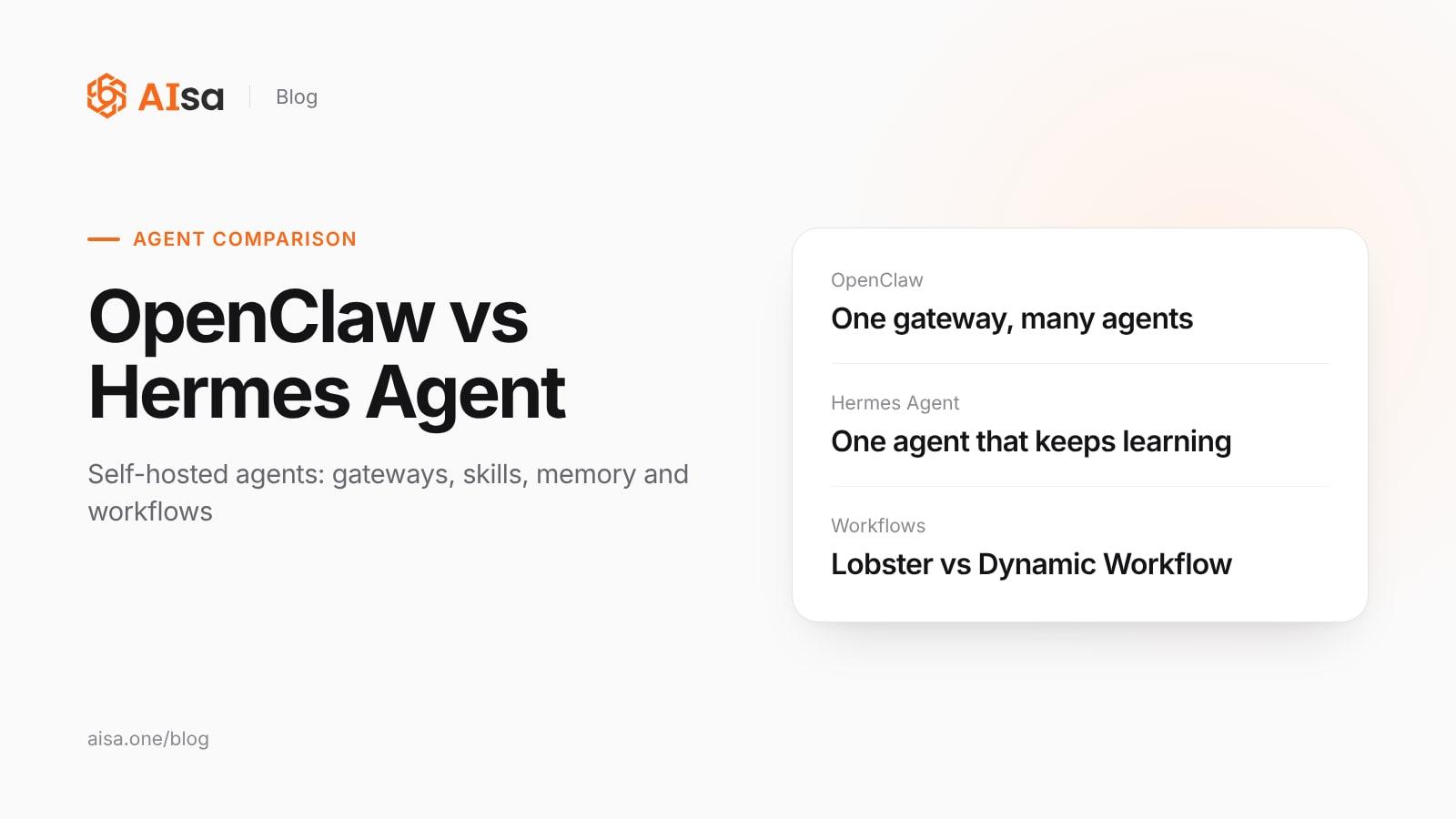
Short answer: Both are open-source agents that you run on your own hardware and reach from chat apps. Pick OpenClaw when you want one gateway that routes many chat accounts to several separate agents, each with its own workspace, credentials and sessions, and you want approval steps in your pipelines. Pick Hermes Agent when you want one agent that remembers across sessions, writes its own skills, and runs large fan-out jobs with the Dynamic Workflow skill or durable graphs with the hermes-workflows plugin.
Key takeaways
- Both are self-hosted, MIT-licensed and model-agnostic. OpenClaw is stewarded by the OpenClaw Foundation. Hermes Agent comes from Nous Research.
- OpenClaw is built around a gateway and many agents. Bindings route each channel account or sender to an agent with its own workspace, auth profiles and session store.
- Hermes is built around one agent that improves with use. It curates its own memory, searches past sessions and saves new procedures as skills.
- Workflows differ. OpenClaw has Lobster, an optional plugin for step pipelines with approval and resume. Hermes has the Dynamic Workflow skill for fan-out work inside one turn and the hermes-workflows plugin for durable JSON graphs.
- Both speak MCP. The last section connects each one to AIsa, so both agents get the same 6,000+ APIs and 110+ models on one key.
What each agent is
OpenClaw
OpenClaw is "an open-source AI assistant that runs on your own hardware and meets you in every chat app you already use." It is MIT-licensed and stewarded by the OpenClaw Foundation (GitHub).
- One gateway. The Gateway process is the single source of truth for sessions, routing and channel connections. Channels include Discord, iMessage, Slack, Microsoft Teams, Telegram, WhatsApp, Google Chat, Signal, Matrix and Zalo, plus 20+ more through plugins.
- Many agents. Each agent has its own workspace files (
AGENTS.md,SOUL.md,USER.md), auth profiles, model registry and session store. Credentials are not shared between agents by default (multi-agent routing). - Skills and ClawHub. Skills are procedures the agent loads when it needs them. ClawHub is the plugin marketplace.
- Automation. Cron jobs (one-shot reminders, intervals and cron expressions), hooks on lifecycle events, authenticated webhooks, and standing orders in
AGENTS.mdthat apply to every session (automation). - Install. Node 24 or 26, then
curl -fsSL https://openclaw.ai/install.sh | bashon macOS, Linux or WSL2.openclaw gateway installandopenclaw gateway startrun it as a background service.
Hermes Agent
Hermes Agent is an MIT-licensed agent from Nous Research (GitHub). It is built to stay running and to get better with use.
- Runs where you put it. Six terminal backends: local, Docker, SSH, Daytona, Modal and Vercel Sandbox.
- Memory across sessions. The agent curates its own memory and searches past sessions (SQLite FTS5 with LLM summaries).
- Skills it writes itself. After a hard task, Hermes saves the procedure as a skill and improves it on later runs. Skills use the agentskills.io format.
- One gateway, many chat apps. Telegram, Discord, Slack, WhatsApp, Signal, Matrix, email, SMS, Microsoft Teams and more from one process.
- Cron, subagents and MCP. Scheduled jobs deliver results to any connected platform, subagents split parallel work, and MCP servers add tools.
Harness capability comparison
| OpenClaw | Hermes Agent | |
|---|---|---|
| Maker | OpenClaw Foundation and community | Nous Research |
| License | MIT | MIT |
| Design center | One gateway, many isolated agents | One agent that learns across sessions |
| Chat apps | 10 listed, plus 20+ through plugins | 20+ from one gateway |
| Routing | Bindings map channel accounts and senders to separate agents, each with its own credentials | One gateway process serves every connected platform |
| Skills | Loaded on demand; ClawHub marketplace | Written and improved by the agent; agentskills.io format |
| Memory | Per-agent workspace files and session store | Agent-curated memory plus cross-session search |
| Scheduling | Cron, hooks, webhooks, standing orders | Built-in cron |
| Delegation | Sub-agents; coordinator and specialist team preset | Subagents through delegate_task |
| Multi-step workflows | Lobster plugin: pipelines with approvals and resume | Dynamic Workflow skill; hermes-workflows plugin for durable graphs |
| Models | Any provider, with failover and local models | Any provider you configure |
| MCP | Yes | Yes |
The table reflects each project's documentation on 2026-11-15. Both projects ship changes every few weeks, so check the linked docs before you decide.
Workflows: Hermes Dynamic Workflow, hermes-workflows and OpenClaw Lobster
A single prompt works for small jobs. For "review 200 files" or "research 40 companies, then check each claim," both projects add a layer that keeps the plan outside the model's context.
Hermes: the Dynamic Workflow skill
Dynamic Workflow (version 2.0.0, by Teknium) is an optional skill for "plan-in-code fan-outs, adversarial verification, waves." Install it with:
hermes skills install official/autonomous-ai-agents/dynamic-workflowIt splits work into two layers:
- Layer A, an
execute_codescript, for deterministic work: fetch N URLs, parse N files, run N commands, merge outputs. - Layer B, a
delegate_taskbatch, for judgment work: classify, review, decide or write one unit. Each task is an isolated agent.
It describes three shapes. A one-shot fan-out is worth it from about 10 units. Adversarial convergence runs 2 to 4 independent attempts, then refuters that try to break each claim, for at most 3 rounds. A campaign runs dozens of workers in waves over hours, with 12 to 16 at a time.
Two settings limit it. delegation.max_concurrent_children (default 10) caps one batch, and delegation.max_spawn_depth must be at least 2 if children fan out themselves. The skill does not survive a restart: delegation is turn-scoped and ends with the process.
Hermes: the hermes-workflows plugin
For work that must survive a restart, the hermes-workflows plugin (version 1.4.9, Hermes Agent v2026.9.21 or later) runs a JSON graph of agent, gate, echo and join nodes in a background runner. Each run is stored under ~/.hermes/workflows/<run-id>/ and "survives session end, gateway restart and plugin disable." On resume, finished nodes are replayed from storage instead of run again.
hermes plugins install hermes-workflows
hermes plugins enable hermes-workflows
OpenClaw: Lobster and sub-agents
Lobster "runs multi-step tool pipelines as one repeatable tool call." A pipeline is an inline command chain or a YAML or JSON file with steps. A step can set approval: required. The run then stops with needs_approval and returns a resume token, and you continue or cancel it. Lobster is an optional plugin:
openclaw plugins install @openclaw/lobsterThen add "lobster" to tools.alsoAllow. Lobster is disabled in sandboxed tool contexts.
For judgment work in parallel, OpenClaw uses sub-agents and a team preset: a coordinator agent assigns bounded work to specialist agents and checks what they return. The docs note that delegationMode: "prefer" is "prompt guidance, not a scheduler."
When to choose which
Choose OpenClaw for many people or many roles on one gateway
OpenClaw fits a household, a team or a small business where different people or channels need different agents. A work WhatsApp account can go to one agent and a family Telegram group to another, each with its own files and credentials. Lobster fits jobs that need a human approval step, such as "draft the emails, then wait for my approval before sending."
Choose Hermes Agent for one agent that gets better at your work
Hermes fits a single owner or team that wants the agent to remember past work, turn repeated tasks into skills, and run large research or review jobs. Dynamic Workflow covers fan-out inside one session. hermes-workflows covers long jobs that must resume after a restart. To compare Hermes with coding agents instead, see Hermes Agent vs Claude Code vs Codex.
Operate either one with care
Both agents run tools on your machine and read messages from outside. OpenClaw's docs say to treat inbound messages as untrusted input, and it pairs unknown senders before it answers them in direct messages. For both agents, keep keys in environment variables, give each agent only the tools it needs, and run it in a sandbox or on a separate server when it handles messages from people you do not know.
Give both agents the same tools with AIsa
Each agent reaches the web, social platforms, company data or markets only through the tools you connect. AIsa is one MCP server and one API key for 6,000+ APIs and 110+ models. The server is https://mcp.aisa.one/mcp, and sign-in uses OAuth in the browser.
OpenClaw (guide):
openclaw mcp add aisa --url https://mcp.aisa.one/mcp --transport streamable-http --timeout 30 --auth oauth
openclaw mcp login aisa
openclaw mcp probe
openclaw gateway restart
openclaw mcp probe should list aisa: 7 tools. Keep --transport streamable-http: without it, OpenClaw connects over SSE and the server answers 405.
Hermes Agent (guide; for the desktop app, see Connect AIsa to Hermes Desktop):
hermes mcp add aisa --url https://mcp.aisa.one/mcp --auth oauth
hermes mcp test aisa
AIsa can also be the model provider for both. OpenClaw takes it as a provider in ~/.openclaw/openclaw.json with baseUrl https://api.aisa.one/v1 and "api": "openai-completions", and models such as aisa/kimi-k2.5. Hermes takes https://api.aisa.one/v1 as a custom OpenAI-compatible endpoint. The guides above have the exact settings, and the model catalog lists the models and prices.
FAQ
What is the difference between OpenClaw and Hermes Agent?
Both are self-hosted, open-source agents that you reach from chat apps. OpenClaw centers on a gateway that routes channels and senders to several isolated agents. Hermes centers on one agent that keeps memory across sessions and writes its own skills.
Is OpenClaw or Hermes Agent free?
Both are free under the MIT license. You pay for the model provider, the APIs the agent calls, and the machine it runs on.
What is Hermes Dynamic Workflow?
An optional Hermes skill for large jobs. It plans in code, fans work out to isolated subagents in batches, and can run adversarial checks on the results. It does not survive a restart. For durable runs, use the hermes-workflows plugin.
Does OpenClaw have workflows?
Yes. The optional Lobster plugin runs step pipelines from a YAML or JSON file, with approval checkpoints and resume tokens. Cron jobs, hooks and webhooks start work on a schedule or on an event.
Can OpenClaw and Hermes Agent use the same tools?
Yes. Both support MCP, so one MCP server such as AIsa gives both agents the same APIs and models.
Sources
- OpenClaw documentation: multi-agent routing, automation, Lobster, and the repository, read 2026-11-15
- Hermes Agent documentation, the Dynamic Workflow skill, the hermes-workflows plugin, and the repository, read 2026-11-15
- AIsa setup guides for OpenClaw and Hermes Agent