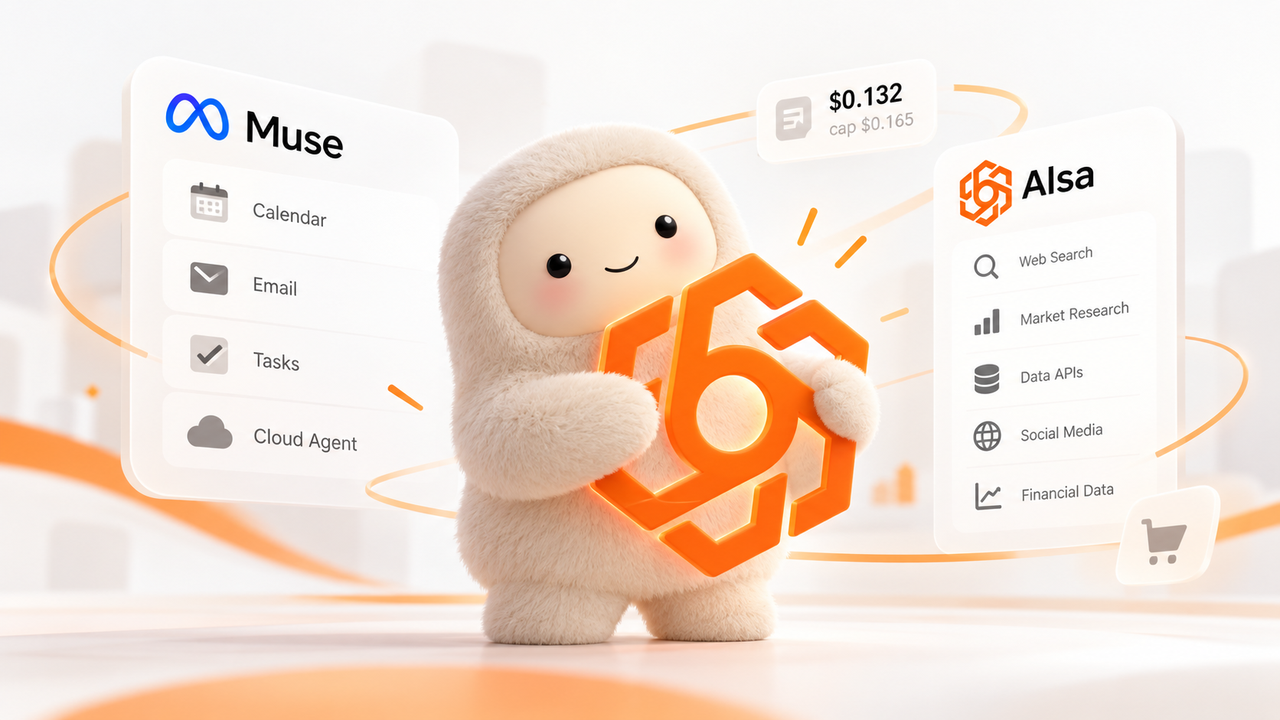
Disclosure: The author works at AIsa, and AIsa is our product. All Muse impressions and screenshots come from the author's own use.
The short version: Muse makes personal AI something you can use without learning anything. After a single OAuth sign-in to AIsa, it can also call paid data services on its own to handle specialist tasks. Meanwhile, Amazon's move to block Muse shows that once AI agents become the front door, retailers must decide whether to be called by agents or to run their own.
Who this is for
This post is for e-commerce teams and developers building AI products. Muse's chart position isn't the story. The story is the shift behind it: people are starting to hand tasks to AI instead of just asking it questions. That changes where your traffic comes from and where buying decisions are made.
What is Muse?
Muse is a personal AI app from Meta. It connects to your calendar, email, and the tasks on your phone, and if a task isn't finished on your phone, a cloud machine keeps working on it. Muse reached No. 1 overall on the US App Store within 10 days of launch.
How I tested it
I used Muse heavily on the free plan for a few days, using it as a personal assistant for everyday work: scheduling, handling email, and, after connecting AIsa through OAuth, running SEO competitor research. The four takeaways below all come from that stretch of real use.
Takeaway 1: So simple you never manage context
Muse doesn't ask you to understand how it works, craft prompts, or start fresh chats to keep topics separate. I handled unrelated tasks in the same conversation, and its memory held up well. I never had to repeat the background I'd already given it.
Most AI products of the past two years quietly assumed the user already knew how to use AI. Muse flips that: the AI adapts to the person. I think kids and grandparents alike could pick it up without help.
Takeaway 2: Rio makes AI feel approachable

Most AI products feel like tools. Muse's soft, fluffy character, Rio, makes it feel more like a companion. For people new to AI, that warmth lowers the barrier to trying it the first time.
Takeaway 3: It goes a long way, with heavy use taking just 2% of the weekly limit
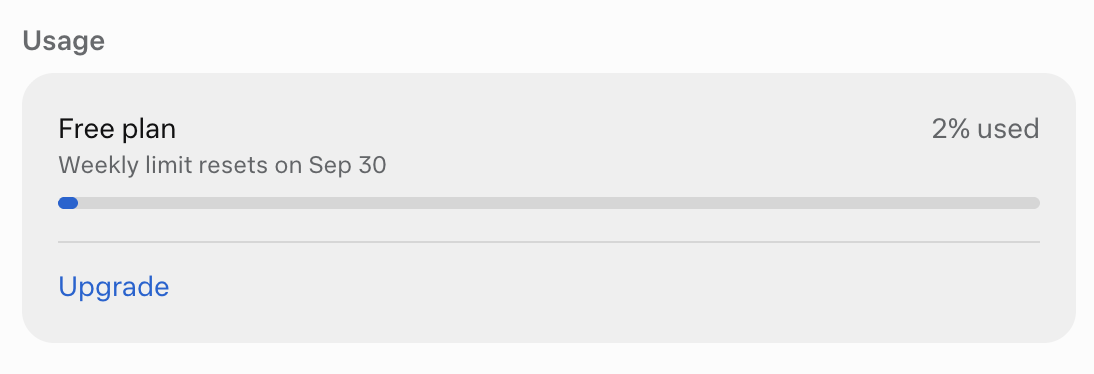
I used the free plan heavily, and when I took this screenshot I'd used only 2% of my weekly limit. If you want to try it before paying, there's plenty of room.
Takeaway 4: One OAuth sign-in, and the assistant can use professional data services
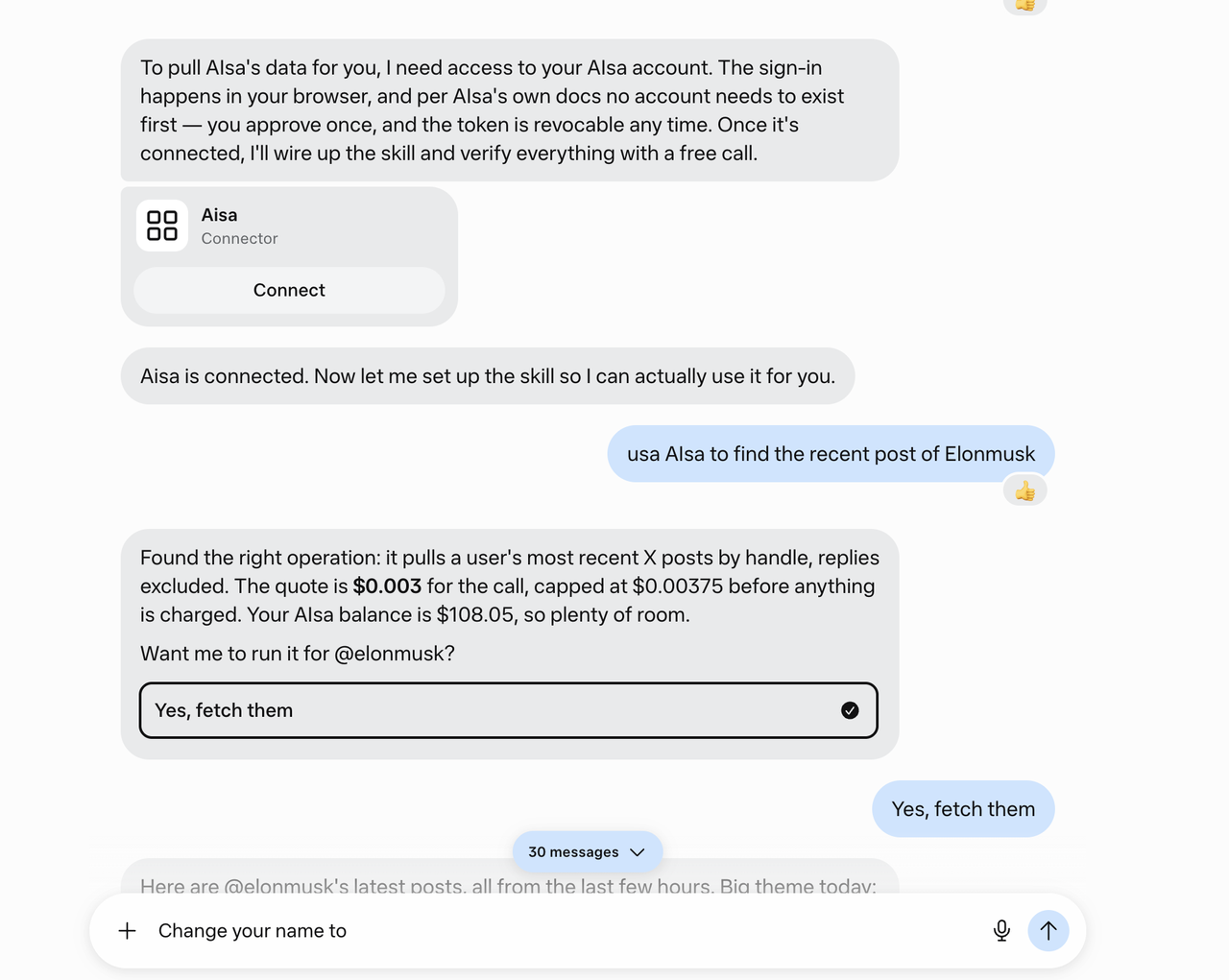
This is the part I most want to share. I asked Rio to use AIsa to find keywords a competitor ranks for that we haven't covered yet.
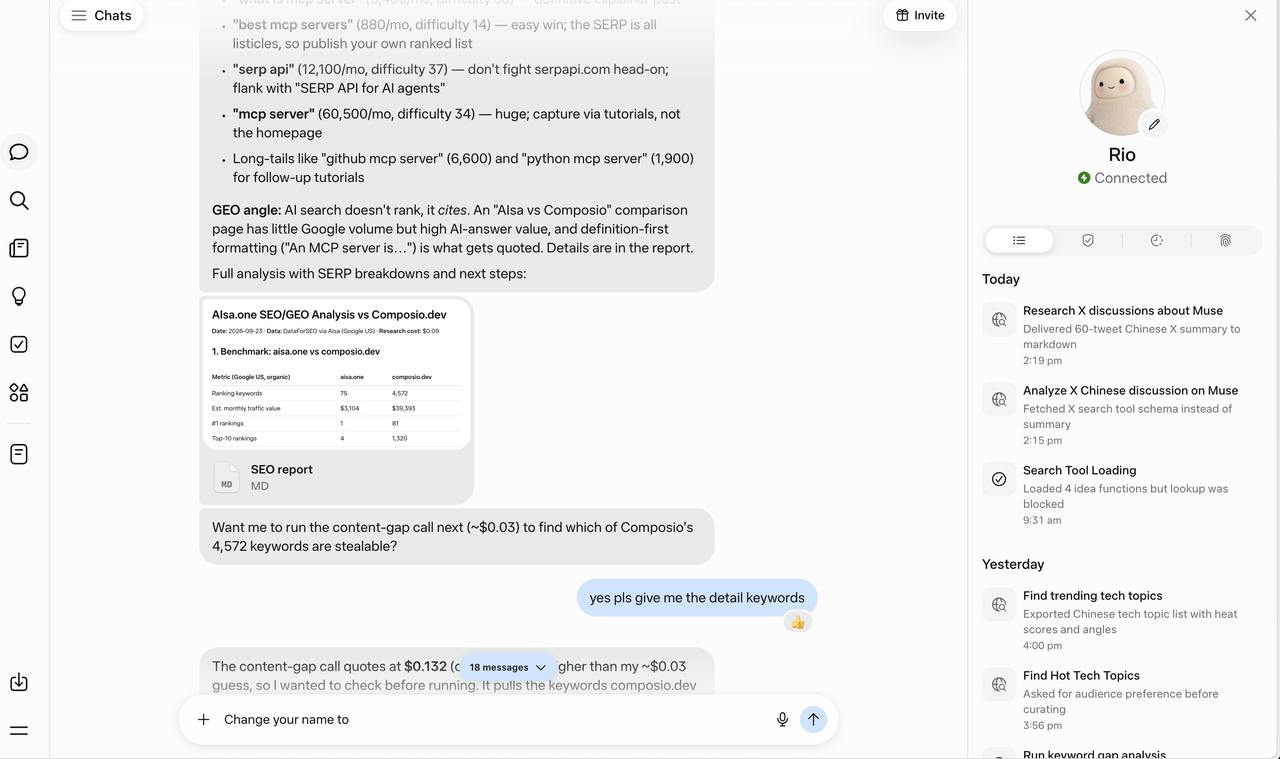
Three details stood out:
- A quote before anything runs. Before the call, AIsa quoted $0.132 for the content-gap analysis, with a cap of $0.165.
- It checks in when the price is higher than expected. Rio had estimated about $0.03. When the quote came back higher, it stopped and asked me before running it.
- The actual charge came in under the quote. By Rio's count, every call in this session cost well below its quote; one plan quoted at $0.60 ended up costing $0.09.
To me, this is what an agent should look like: able to use real professional services, while leaving spending decisions with the person.
A new shape for personal AI: from answering to finishing
What separates Muse from a traditional chatbot is that it acts across apps, and the work doesn't stop when you put your phone down. Instead of opening five apps to get one thing done, you hand it to an agent.
For e-commerce, that means comparing prices, placing orders, and tracking shipments may increasingly happen through an agent. Your shopper might never see your storefront, just a one-line recommendation from their assistant.
What Amazon blocking Muse tells us
According to this Hacker News thread, Amazon has blocked Muse.
My opinion: if shoppers get used to buying through third-party agents, a marketplace risks turning from a destination people visit into a backend that agents query. Traffic, customer data, and ad inventory would all be up for grabs. Amazon's caution makes sense, and it raises a question for every seller: is your business ready to be understood and used by AI agents?
Three things e-commerce teams and developers can do now
- Make your products and services agent-ready. Structured, accurate, complete data is what lets an agent recommend you correctly.
- Let agents call your service directly. My AIsa experience shows that one OAuth sign-in plus clear per-call pricing is enough for an agent to use a paid service with confidence.
- Decide whether you need your own agent. Platform rules are still shifting. If your customers reorder often or need pre-purchase help, an agent of your own keeps that relationship in your hands.
Where AIsa fits
As noted above, AIsa is the author's company's product.
AIsa is the resource layer for AI agents. Based on this experience inside Muse, it stands out in three ways:
- Easy to connect: personal AI apps like Muse can use it after a single OAuth sign-in
- Pay per call, with transparent pricing: every call is quoted up front, with a spending cap
- Professional data capabilities: for example, go-to-market research, SEO content-gap analysis, social media content lookup, and financial analysis
Learn more: aisa.one/api
FAQ
What is Muse?
Muse is Meta's personal AI app. It connects to your calendar, email, and phone tasks, and keeps unfinished tasks running in the cloud.
Do I need to write prompts or start new chats in Muse?
No. You describe what you need in plain language, and it manages conversation memory itself, so there's no need to open new chats to separate topics.
Is the Muse free plan enough?
In the author's experience, a stretch of heavy use consumed only 2% of the weekly limit.
How does Muse connect to third-party services?
Taking AIsa as an example, one OAuth sign-in lets the assistant use the service, and it quotes and confirms before any paid call.
Sources
- Muse reaching No. 1 on the US App Store: Fox Business
- Amazon blocking Muse: Hacker News
- Meta's official Muse page: ai.meta.com/muse